


'%20clip-path='url(%23master_svg0_435_106539/302_155699)'%3e%3cg%20transform='matrix(0,1,1,0,-10,10)'%3e%3cpath%20d='M4.64651757818006,15.35348295818006Q4.57620548818006,15.283170878180059,4.538152908180059,15.19130372818006Q4.500100258180059,15.09943655918006,4.500100258180059,15.00000026818006Q4.500100288180059,14.950764414180059,4.50970571818006,14.90247461918006Q4.519311158180059,14.854184818180059,4.538152908180059,14.80869683818006Q4.556994648180059,14.76320883818006,4.5843486181800595,14.72227072818006Q4.6117025881800595,14.68133261818006,4.646517608180059,14.64651760818006Q4.681332618180059,14.611702588180059,4.722270728180059,14.58434864818006Q4.763208838180059,14.55699467818006,4.80869683818006,14.53815292818006Q4.85418481818006,14.51931115818006,4.90247461918006,14.50970571818006Q4.9507644141800595,14.50010028818006,5.0000002681800595,14.50010025818006Q5.0994365591800594,14.50010025818006,5.19130372818006,14.53815290818006Q5.2831708781800595,14.57620548818006,5.353482958180059,14.64651757818006L5.35355364818006,14.64644688818006L8.00000026818006,17.29289366818006L10.64644696818006,14.64644688818006L10.646517568180059,14.64651757818006Q10.71682956818006,14.57620548818006,10.808696968180058,14.53815290818006Q10.90056446818006,14.50010025818006,11.00000026818006,14.50010025818006Q11.049235568180059,14.50010028818006,11.09752536818006,14.50970571818006Q11.14581516818006,14.51931115818006,11.19130356818006,14.53815290818006Q11.236791368180059,14.55699464818006,11.277729768180059,14.58434861818006Q11.318667668180058,14.611702588180059,11.35348296818006,14.64651760818006Q11.388298268180058,14.68133261818006,11.415652068180059,14.72227072818006Q11.443005868180059,14.76320883818006,11.461847568180058,14.80869683818006Q11.48068926818006,14.854184818180059,11.49029476818006,14.90247461918006Q11.499900168180059,14.950764414180059,11.499900168180059,15.00000026818006Q11.49989966818006,15.09943664118006,11.461846668180058,15.191303868180059Q11.42379406818006,15.28317108818006,11.35348246818006,15.35348319818006L11.353553068180059,15.353553648180059L8.35355356818006,18.35355356818006Q8.283227468180058,18.42387966818006,8.191341868180059,18.46193986818006Q8.099456068180059,18.50000006818006,8.000000068180059,18.50000006818006Q7.9005439681800596,18.50000006818006,7.80865836818006,18.46193986818006Q7.71677286818006,18.42387966818006,7.64644696818006,18.35355356818006L4.646446888180059,15.353553648180059L4.64651757818006,15.35348295818006Z'%20fill-rule='evenodd'%20fill='%23A0A2A2'%20fill-opacity='1'%20style='mix-blend-mode:passthrough'/%3e%3c/g%3e%3c/g%3e%3c/svg%3e)
'%3e%3cg%20transform='matrix(0,-1,1,0,-4,14)'%3e%3cpath%20d='M4.57582074,9.42417926Q4.49144626,9.33980477,4.44578308,9.22956416Q4.40011996,9.11932355,4.40011996,9Q4.40012002,8.940916978,4.41164654,8.88296923Q4.42317307,8.82502148,4.4457832,8.77043588Q4.46839327,8.71585029,4.50121802,8.66672456Q4.53404278,8.61759883,4.5758208,8.5758208Q4.61759883,8.53404278,4.6667245600000005,8.50121802Q4.71585029,8.46839321,4.77043588,8.44578314Q4.82502148,8.42317307,4.88296923,8.41164649Q4.940916978,8.40012002,5,8.40011996Q5.11932355,8.40011996,5.22956416,8.44578314Q5.33980477,8.49144626,5.42417926,8.57582074L5.4242640699999995,8.57573593L8,11.1514719L10.575736,8.57573593L10.5758209,8.57582062Q10.6601949,8.4914462,10.770435299999999,8.44578314Q10.880676300000001,8.40012002,11,8.40011996Q11.059083000000001,8.40012002,11.117030100000001,8.41164654Q11.1749778,8.42317307,11.229563200000001,8.4457832Q11.2841492,8.46839327,11.3332748,8.50121802Q11.3824005,8.53404278,11.4241791,8.5758208Q11.4659567,8.61759883,11.4987817,8.66672456Q11.531606700000001,8.71585029,11.5542164,8.77043588Q11.5768266,8.82502148,11.5883532,8.88296923Q11.599880200000001,8.940916978,11.599880200000001,9Q11.599880200000001,9.1193236,11.5542164,9.22956422Q11.5085535,9.33980486,11.4241791,9.42417938L11.424264,9.42426407L8.424264,12.424264Q8.3398728,12.508655300000001,8.229610000000001,12.5543277Q8.1193473,12.5999999,7.999999799999999,12.5999999Q7.8806524,12.5999999,7.7703898,12.5543275Q7.6601272,12.5086551,7.5757358,12.424264L4.5757359300000005,9.42426407L4.57582074,9.42417926Z'%20fill-rule='evenodd'%20fill='%23000000'%20fill-opacity='1'/%3e%3c/g%3e%3c/g%3e%3c/svg%3e)
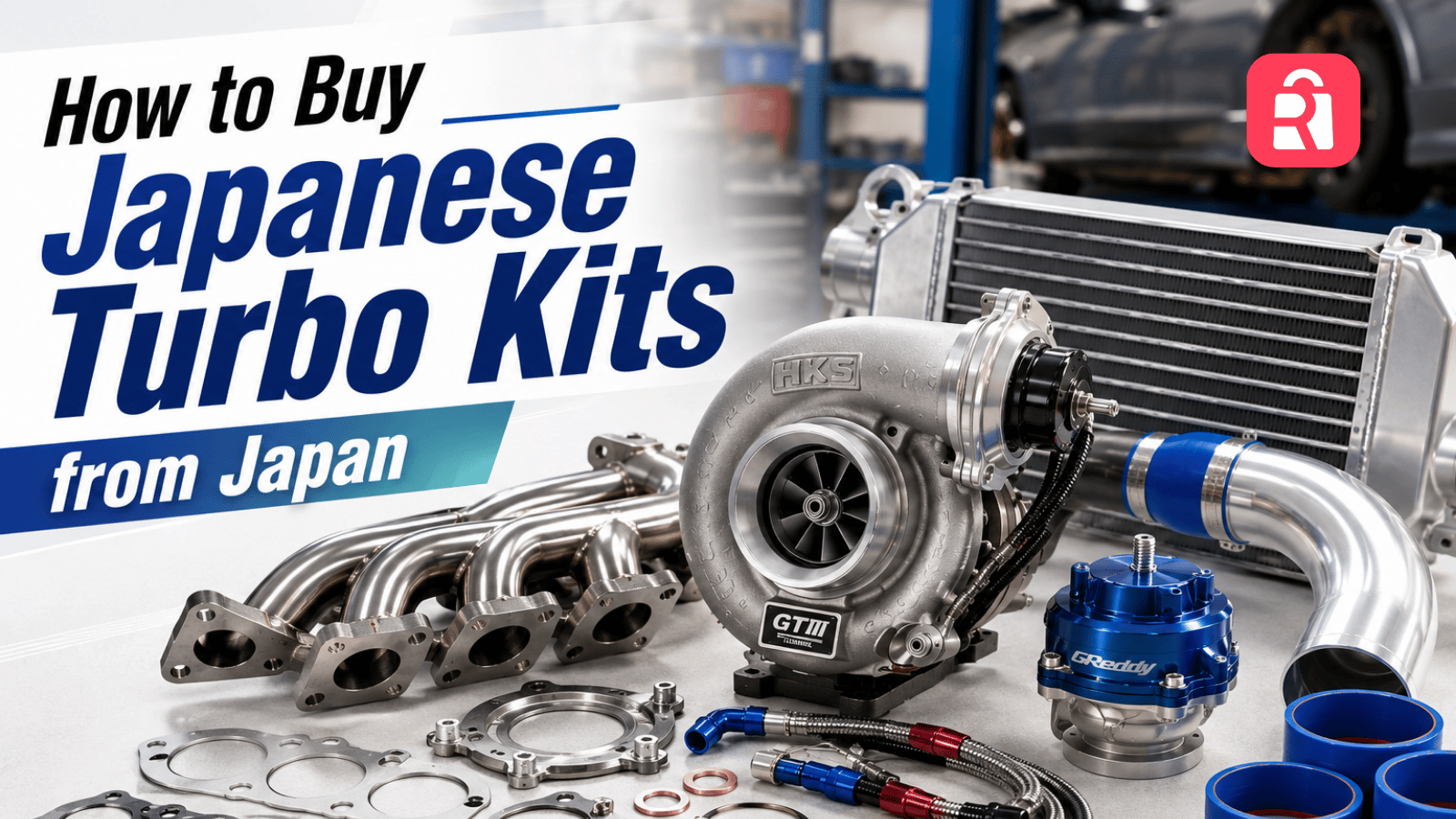
Japanese turbo kits occupy a unique space in the automotive world. They sit at the intersection of race-proven engineering, meticulous manufacturing, and a tuning culture that values both power delivery and long-term reliability. For enthusiasts looking to extract more from their engine, Japanese turbo kits have earned a reputation as the gold standard.
Whether you drive a Nissan Skyline, Toyota Supra, Subaru BRZ, or Suzuki Jimny, the Japanese aftermarket offers forced induction solutions designed specifically for your platform. This guide explores the leading Japanese turbo kit manufacturers, highlights notable products, and walks you through how to purchase them directly from Japan using Rakufun.
Table of Contents
- Why Japanese Turbo Kits Are Different
- Leading Japanese Turbo Kit Manufacturers
- What to Look for When Buying a Japanese Turbo Kit
- Tips for Buying a Turbo Kit from Japan
- Frequently Asked Questions (FAQ)
- How to Buy Japanese Turbo Kits with Rakufun
- Final Thoughts
Why Japanese Turbo Kits Are Different
Japanese turbo manufacturers are not just parts suppliers—they are engineering companies with deep roots in motorsports. Many started as race teams or tuning shops before developing their own products.
Race-Proven Development. Companies like HKS, GReddy, and SARD have decades of experience on circuits like Tsukuba and Fuji Speedway. Products are tested under extreme conditions before reaching the market.
Platform-Specific Engineering. Unlike universal turbo kits, Japanese manufacturers design for specific engines. Every component—from the exhaust manifold to the intake piping—is engineered to fit without major fabrication.
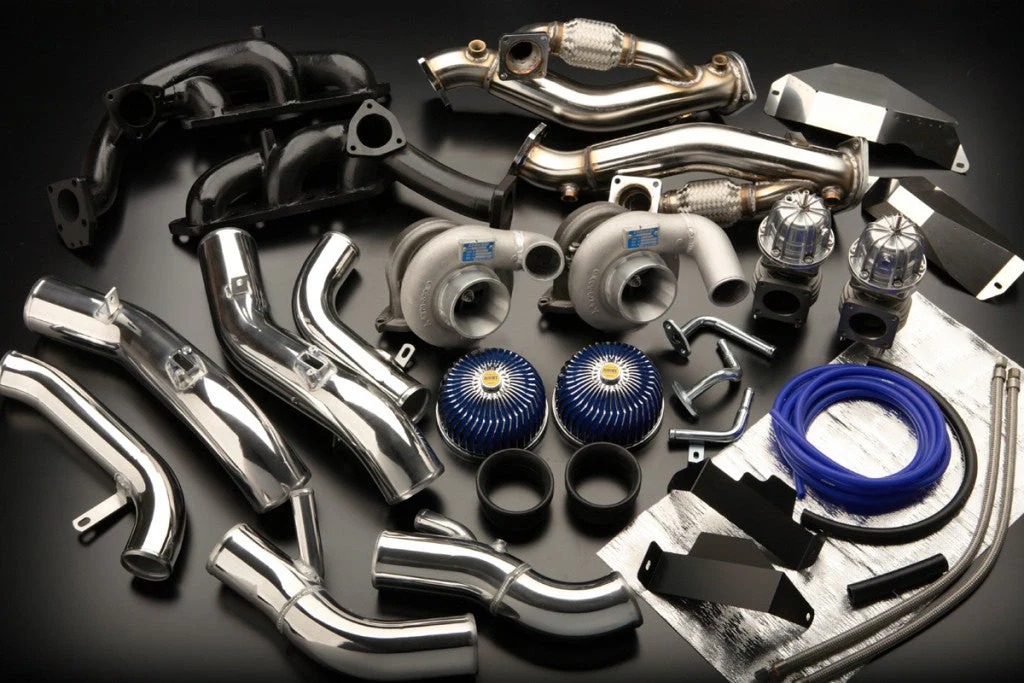
OEM-Level Manufacturing. Japanese turbo kits are produced using high-quality materials. Cast iron and stainless steel manifolds are precision-machined to exacting tolerances.
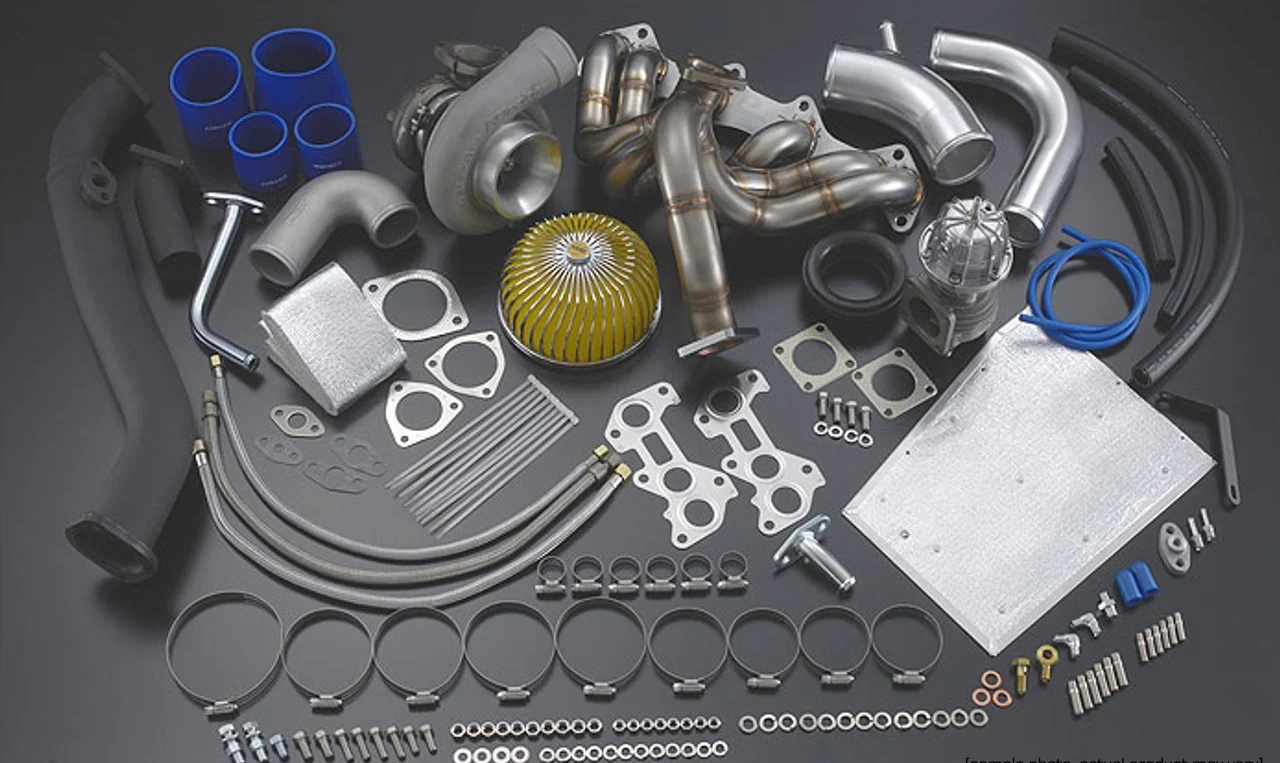
Comprehensive Kit Contents. Most Japanese turbo kits include everything needed for installation: turbocharger, manifold, wastegate, intake pipes, and necessary gaskets and hardware.
Made in Japan Quality. Components are manufactured in Japan with strict quality control. HKS, for example, casts and machines its turbo housings in-house to ensure consistency.
Leading Japanese Turbo Kit Manufacturers
HKS: The Pioneer of Aftermarket Turbocharging
Founded in 1973 in Saitama, Japan, HKS is the most recognized Japanese performance brand globally. In 1982, HKS released the world's first aftermarket turbo kit for the Nissan Skyline GT-R. Since then, the company has continued to push forced induction technology forward.
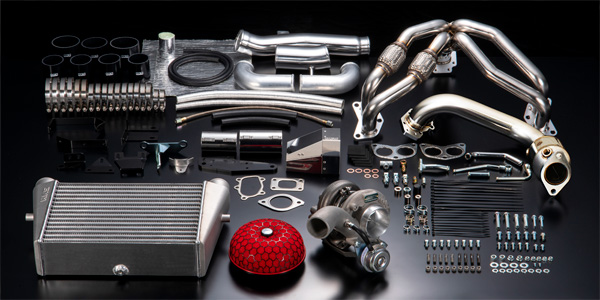
The GTIII-RS turbine series is designed to deliver responsive power while maintaining OEM fitment. It achieves high efficiency with low air flow ranges while preventing surge. The kits are manufactured with domestic castings machined and finished within HKS facilities.
Applications include the Skyline GTS RB25 (330–450ps) and the Subaru BRZ/Toyota 86 FA24 engine (up to 454ps with built engine).
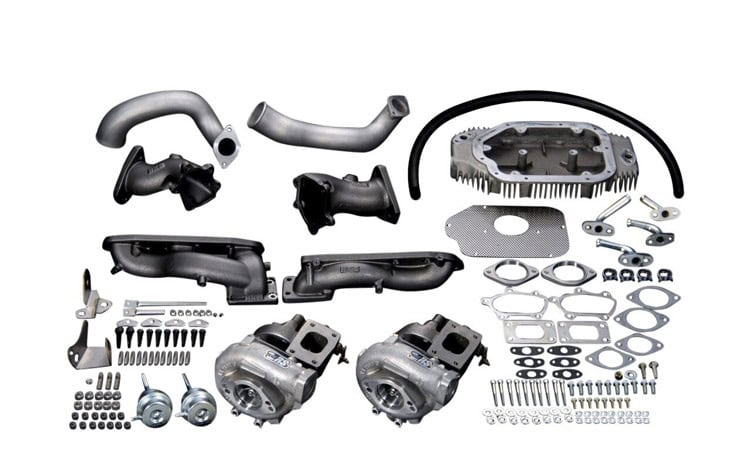
This kit inherits the "symmetry layout" from the GT1000+ kit. At 200 kPa (approximately 29 psi) boost, it produces 1,380 Nm (1,018 lb-ft) of torque at 5,000 rpm and 1,215 ps (1,198 hp) at 6,800 rpm.
Key features include an additional ported shroud to prevent surge during spool-up. The exhaust manifold and turbo housing use heat-resistant cast steel for durability against heat and vibration.
Key offerings include:
- GTIII-RS Sports Turbine Kit – Skyline GTS RB25, 330–450ps, bolt-on design
- GT5565 BB Full Special Turbine Kit – Nissan GT-R R35, 1,200+ps with complete kit
- GTIII-4R Turbo Kit – For high-performance applications
GReddy (Trust): Comprehensive Bolt-On Solutions
GReddy, also known as Trust in Japan, is a major Japanese performance parts manufacturer producing turbo kits, exhaust systems, and electronics. The company specializes in complete bolt-on solutions requiring minimal modification.
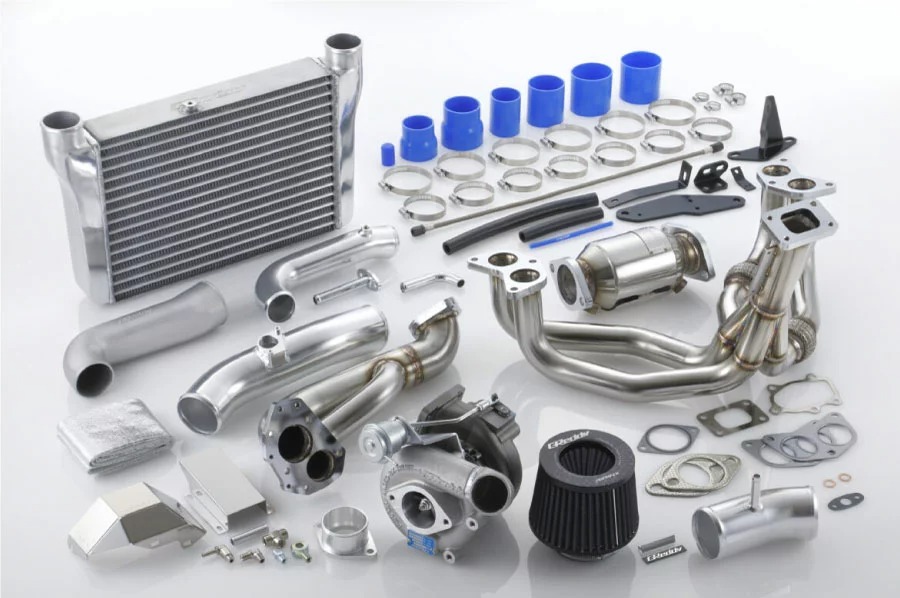
Toyota 86 / Subaru BRZ Turbo Kit
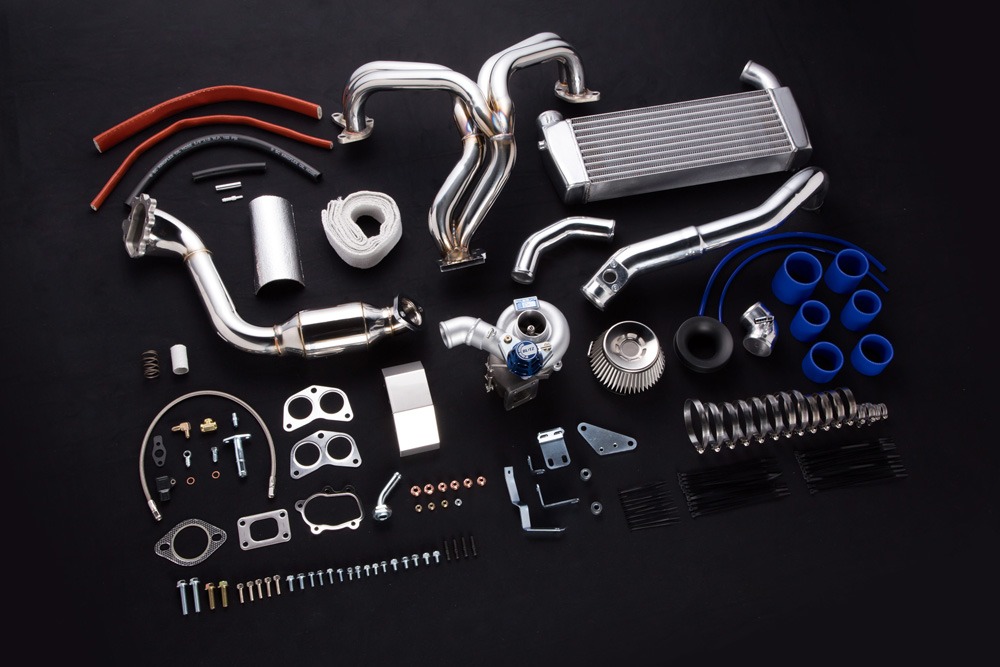
This conversion kit transforms the standard naturally aspirated 86/BRZ into forced induction. It includes a stainless steel exhaust manifold, stainless steel front pipe, metal catalyzer, intercooler kit, Airinx intake, and all necessary hardware.
Turbocharger options include T518Z (~265–280hp) and T620Z (~330–370hp). Power output depends on turbo selection and whether the genuine catalyzer is retained or replaced.
For JZX90 and JZX100 Chaser, Mark II, and Cresta with 1JZ-GTE engines, GReddy offers complete turbo kits featuring TD06SH-25G or TD06SH-20G turbochargers. Each kit includes the exhaust manifold, wastegate, turbo, and intake pipes. Depending on configuration, power targets range from approximately 350 to 700 horsepower.
For the K15B engine, GReddy developed a bolt-on turbo kit using a TF035 turbine. It increases power and torque across the entire rev range. The kit includes the turbine, lost-wax stainless exhaust manifold, intercooler, Airinx intake filter, and all piping. ECU recalibration is required.
Key offerings include:
- Bolt-On Turbo Kit – Toyota 86 / Subaru BRZ, 265–450hp
- Turbo Kit – Toyota JZX90/JZX100 Chaser/Mark II, 350–700hp configurations
- Bolt-On Turbo Kit – Suzuki Jimny JB74 (K15B)
SARD: Race-Bred Engineering with Toyota Expertise
SARD (Sigma Advanced Racing Development) started as a race team and Toyota tuning specialist in the 1970s. The company has since grown into a globally recognized performance brand known for OEM-level quality. SARD is especially trusted for fuel system components (injectors, regulators, pumps) used in 500–1000+ horsepower builds, as well as cooling systems and aero components. The company has deep technical knowledge of Toyota platforms, from the AE86 to the GR Supra.
Many SARD products are manufactured in Japan to exacting tolerances using advanced materials. While SARD is particularly known for its fuel system components, the company's comprehensive engineering expertise makes it a respected name in high-performance forced induction builds.
Key specialties include:
- Toyota/Lexus platform expertise (AE86 to GR Supra)
- Fuel system components for high-horsepower forced induction builds
- Cooling systems and aero components
- In-house R&D and race-proven technology
Tomei Powered: Precision Drop-In Turbo Kits
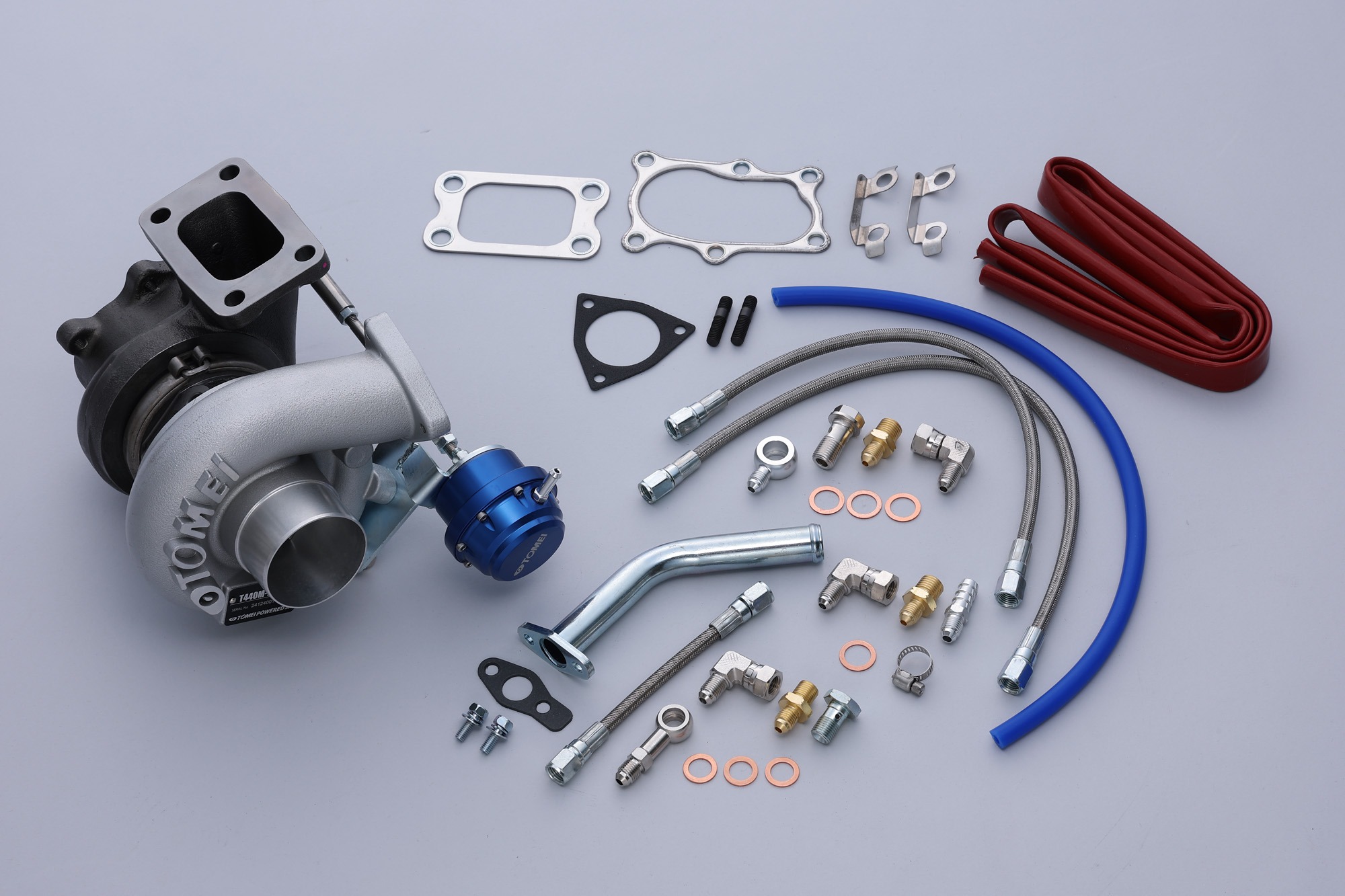
Tomei Powered is a Japanese manufacturer specializing in Nissan engine performance. The company is particularly known for its RB and SR engine products, including the T440M turbo kit for the RB25.
T440M Turbo Kit (RB25)
This kit features a high-grade floating bearing in the CHRA, precisely tuned for an optimal balance of response, torque, and peak power. The reinforced wastegate actuator ensures stable pressure from initial spool-up through the high RPM range.
The kit includes all necessary components for direct drop-in replacement of the OEM turbo: gaskets, bolts, and hardware. It is designed as a complete package, eliminating the need to source individual components separately. An intake adapter kit is available for fitting the T440M to (R)PS13 SR20DET applications.
Key offerings include:
- T440M Turbo Kit – RB25 (Skyline R33/R34, Stagea), direct drop-in replacement
- Intake Adapter Kit – For fitting T440M/T400M to (R)PS13 SR20DET
What to Look for When Buying a Japanese Turbo Kit
Selecting the right turbo kit requires careful evaluation of several factors. The most important consideration is turbocharger selection. Smaller turbos spool faster, providing better throttle response and low-end torque. Larger turbos make more top-end power but introduce more lag. Match the turbo size to your power goals and driving style.
Kit completeness is another critical factor. Quality Japanese kits include the turbocharger, exhaust manifold, wastegate (for external gate setups), intake pipes, front pipe, intercooler (some kits), gaskets, and hardware. Missing components cause delays and add expense.
Material quality directly affects durability. Cast iron and stainless steel manifolds resist cracking under high heat. HKS and GReddy use heat-resistant cast steel for their turbo housings and manifolds, which withstands extreme exhaust temperatures and vibration.
Installation requirements vary between kits. Some are true bolt-on, designed to fit without modification. Others require ECU tuning, fuel system upgrades (injectors, pump), oil pan modification, or removal of factory components like the washer tank. Read the manufacturer's instructions before ordering.
Vehicle compatibility must be verified. Japanese turbo kits are designed for JDM-spec vehicles. If you own an export model (e.g., LHD 86/BRZ or European-spec Skyline), confirm fitment with the manufacturer or consult community forums.
Supporting modifications are almost always necessary. Expect to upgrade fuel injectors and pump, intercooler, engine management (ECU tuning or standalone), and often the clutch to handle increased torque. Some kits also require an oil cooler and colder spark plugs.
Tips for Buying a Turbo Kit from Japan
Confirm fitment before purchasing. Japanese turbo kits are designed for Japanese Domestic Market (JDM) vehicles. If you own an export model (e.g., LHD 86/BRZ or European-spec Skyline), verify compatibility with the manufacturer.
Budget for shipping weight. Turbo kits are heavy—shipping costs can be substantial. Complete kits weigh between 25-50 kg depending on included components. Consolidating with other purchases helps reduce per-item costs.
Expect ECU tuning. Even bolt-on kits require professional tuning. Factor in costs for an aftermarket ECU or reflash, dyno time, and tuning.
Plan for supporting upgrades. Additional components may be required: injectors, fuel pump, intercooler, oil cooler, upgraded clutch, and spark plugs (one heat range colder is common).
Check installation requirements carefully. Some kits require oil pan drilling (GReddy Jimny kit), replacement of specific components, or removal of the factory washer tank. Read the manufacturer's instructions before ordering.
Understand the documentation. Japanese instruction manuals are thorough but written in Japanese. Use translation apps or find English versions online.
Frequently Asked Questions (FAQ)
Q: How much power will a turbo kit add?
A: Depends on the kit, supporting modifications, and tune. GReddy's 86/BRZ kits range from 265–450hp. HKS GTIII-RS on 86/BRZ increases output from 185ps to 342ps on a stock engine.
Q: What's included in a typical Japanese turbo kit?
A: Turbocharger, exhaust manifold, wastegate (external gate kits), intake pipes, front pipe, intercooler (some kits), gaskets, and hardware.
Q: Do I need an aftermarket ECU?
A: Yes. The factory ECU cannot compensate for forced induction without reprogramming. Aftermarket options include standalone ECUs (Haltech, Link, Motec) or reflashed OEM ECUs.
Q: How difficult is installation?
A: Moderate to advanced. Professional installation is recommended, especially for oil line connections, exhaust fitting, and initial tuning.
Q: Where can I find installation instructions?
A: Manufacturers provide manuals. Tomei's T440M manual includes torque specifications, step-by-step procedures, and component diagrams. Some are in Japanese; translation tools help.
Q: Can I install a JDM turbo kit on my export market car?
A: Usually, with modifications. Intake and exhaust routing may differ. Engine and transmission mounts may also differ. Research your specific chassis and engine combination.
How to Buy Japanese Turbo Kits with Rakufun
Japanese aftermarket retailers and individual sellers on platforms like Mercari, Rakuma, Surugaya, and Yahoo! Japan Auctions rarely offer international shipping. Rakufun is a proxy shopping platform (website and mobile app) that gives you access to the full Japanese market. Rakufun partners with dozens of Japanese online stores, handling domestic purchases and international shipping with 0% purchasing fees—you pay only for items and shipping.
Step 1: Find your turbo kit
- Direct Search: Use Rakufun's built-in search to browse items from partnered platforms like Mercari, Rakuma, Surugaya, Rakuten, Amazon JP, and Yahoo! Japan Auctions. Search by brand and model—for example, "HKS GTIII-RS" or "GReddy 86 Turbo Kit."
- Link2Buy Method: If you find a specific kit on a Japanese website that does not ship internationally, copy the product URL and paste it into Rakufun's Link2Buy tool. You will need to manually enter the product name, specification, price (JPY), quantity, and domestic shipping fee.
Step 2: Place your order. Add the kit to your cart and proceed to checkout. Pay for the kit and domestic shipping. Rakufun purchases the kit on your behalf using their local Japanese address.
Step 3: Warehouse arrival. The seller ships the turbo kit to Rakufun's domestic warehouse in Japan. You receive a notification when the package arrives.
Step 4: Consolidate multiple items. Rakufun offers up to 90 days of free warehouse storage. If you are buying additional components (e.g., fuel injectors, ECU, intercooler), wait until everything arrives and then combine into one shipment. This saves significantly on international shipping.
Step 5: Choose international shipping and receive. Select your preferred international shipping method: DHL, EMS, Air Freight, or Sea Freight. Rakufun professionally repacks your items to ensure they are secure for the journey, and you receive a tracking number.
Final Thoughts
Japanese turbo kits represent the pinnacle of forced induction engineering. Whether you choose HKS for its pioneering heritage, GReddy for its complete bolt-on solutions, SARD for its race-proven Toyota expertise, or Tomei for its precision Nissan-focused designs, you are investing in decades of motorsport experience.
When purchasing directly from Japan, pay attention to turbocharger selection, supporting modifications, and installation requirements. Plan for ECU tuning and budget for shipping heavy components. With Rakufun handling the logistics, the process is straightforward and cost-effective.